
Grid-Tied vs. Off-Grid vs. Hybrid BESS: A C&I Developer’s Guide to ROI and Technical Selection

As the penetration of renewable energy continues to rise, battery energy storage systems (BESS) have evolved from optional ancillary equipment to core assets in corporate energy strategies. Different application scenarios impose vastly different requirements on grid connection methods, power supply reliability, and economic returns. Currently, energy storage architectures on the market are primarily divided into three categories: Grid-Tied Battery Energy Storage Systems (BESS), Off-Grid Battery energy storage systems (BESS), and Hybrid Battery Energy Storage Systems (BESS).
A clear understanding of the technical differences and commercial applicability of these three types is essential to avoid overinvestment or functional gaps. This blog provides a practical decision-making guide by examining three key dimensions: operational logic, real-world business cases, and selection criteria.
Grid-Tied BESS: Maximizing Energy Economic Benefits
Grid-Tied BESS are directly connected to the public grid and support bidirectional power flow. Their core value lies in leveraging time-of-use pricing or the peak-and-off-peak characteristics of solar power output to implement load shifting and arbitrage strategies.
Key Commercial Applications
- Time-of-use pricing arbitrage: Charging during off-peak hours and discharging during peak hours directly reduces electricity costs.
- Optimize PV Self-Consumption: Storing excess solar power generated during the day for use in the evening or on cloudy days, thereby increasing the proportion of renewable energy consumed.
- Grid ancillary services: Capable of frequency regulation and demand response; in some markets, the system can participate in ancillary service auctions to generate revenue.
Key Limitations
It is essential to note that Grid-Tied BESS cannot provide any backup power to local loads. Grid-Tied BESS lack local backup power capabilities. In the event of a public grid outage, according to European DIN VDE V 0126-1-1 or North American IEEE 1547 standards, the system's anti-islanding protection must be triggered within milliseconds, causing the inverter to shut down immediately. Furthermore, in Germany or the UK, the interconnection application process for grid-tied projects can take as long as 6–18 months, meaning that purely grid-tied assets will remain idle until approval is granted.
Case Study
River Island Microgrid (Weak Grid & Eco-Sensitive Zone): A 2.9 km² river island in Asia suffered frequent outages due to an aging cross-river line. Traditional grid expansion would cost $6.4M and threaten a water conservation zone. Instead, the island deployed 2.1 MWp PV + micro-wind + a 2.125 MW / 3.865 MWh Grid-Forming BESS. Upon grid failure, the system islanded automatically, backing up critical aquaculture for 3 hours and residential loads for 25 hours. Total CAPEX was only $1.34M, slashing costs by 79% ($5M+ savings) with 100% local renewable consumption.
Off-Grid BESS: Achieving Complete Energy Self-Sufficiency
Off-Grid BESS have no physical connection to the public grid and constitute an independent, self-sustaining power system. A typical configuration includes a photovoltaic array, a wind turbine, or a diesel generator, along with a precisely sized battery bank.
Core Application Scenarios
- Areas without grid coverage: Sites such as remote islands, deserts, and mountainous regions that lack access to the power grid.
- Critical facilities requiring high reliability: Data centers, communication base stations, medical facilities, and other sites with extremely stringent requirements for power supply continuity.
Design Challenges and Cost Considerations
Off-Grid BESS must be designed to withstand the most extreme operating conditions, typically based on the periods of the year with the poorest sunlight and wind conditions. This necessitates significantly oversizing both the PV array and battery capacity to ensure that all critical loads can be supported even during prolonged periods of no wind and no sunlight. Consequently, the initial capital investment is significantly higher than for other solutions, and more specialized operation and maintenance are required. Off-Grid BESS are a choice driven by the necessity of power supply or critical safety needs, rather than merely a means to reduce electricity costs.
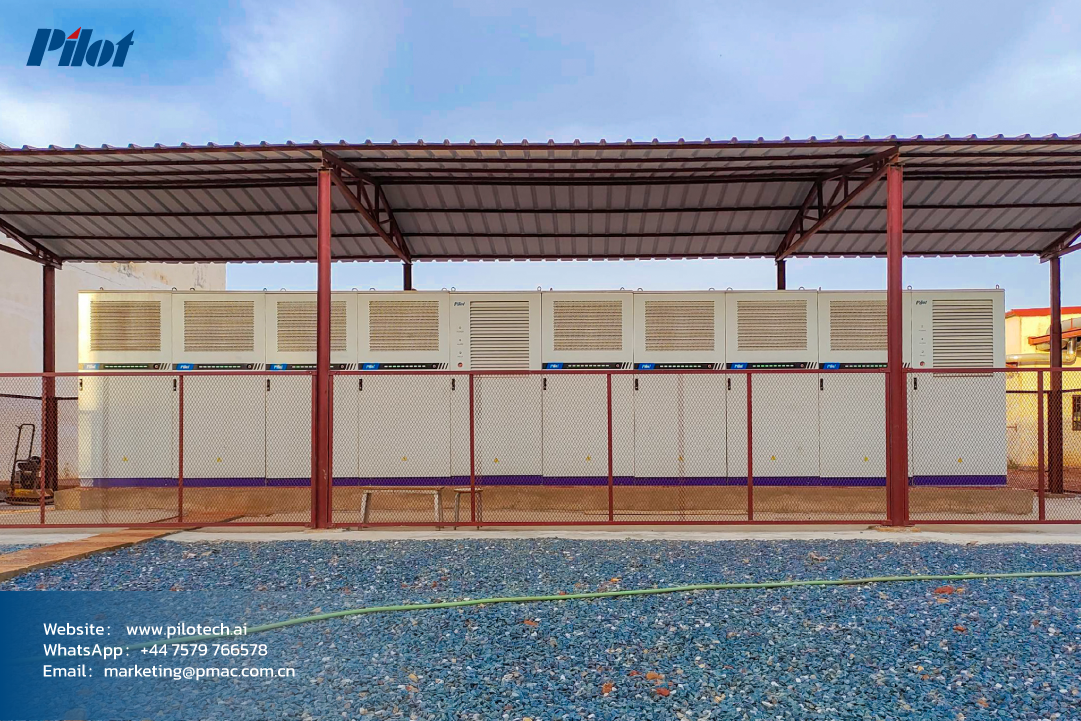
Case Study
Pharma Factory Microgrid in Africa (Weak Grid & Ultra-Reliable Supply): Humanwell (Africa) Pharma's Mali facility faced frequent grid outages that threatened GMP compliance, while relying on expensive diesel power. To resolve this, the plant deployed 2.0 MWp PV + 1.0 MW / 2.08 MWh liquid-cooled BESS and a microgrid control system. Featuring millisecond-level seamless switching, it guarantees 99.9% production stability. Achieving 100% self-sufficiency, the microgrid slashed LCOE by 70% compared to diesel, saving 820,000 liters of diesel annually and cutting total power costs to just 30%.
Hybrid BESS: Balancing Cost-Effectiveness and Power Supply Reliability
Hybrid BESS integrate both grid-tied and off-grid operating modes. When the grid is stable, the system operates in grid-tied mode, implementing electricity cost optimization strategies; when a grid outage is detected, the system switches to off-grid mode within milliseconds, “islanding” itself from the grid to independently supply power to pre-designated critical loads.
Core Value Proposition
This architecture offers an ideal solution for businesses that need to continuously reduce energy costs but cannot tolerate power outages for critical loads. It serves as instant insurance against grid failures without sacrificing the economic benefits of daily operations.
Framework for Enterprise Selection Decisions
When selecting an appropriate energy storage architecture, it is recommended to evaluate the following three criteria in sequence, rather than directly comparing technical specifications.
|
Evaluation Criteria |
Grid-Tied BESS |
Off-Grid BESS |
Hybrid BESS |
|
Primary Business Drivers |
Dynamic peak shaving and arbitrage, increased renewable energy integration |
Power supply in off-grid areas, extremely high-reliability backup power |
Balances electricity cost optimization with uninterrupted backup power for critical loads |
|
Power Outage Response Capability |
None (forced shutdown due to anti-islanding protection) |
Full-time coverage (operates as the primary power source) |
Available (10–20 ms seamless switching for critical loads) |
|
Initial System CAPEX |
Low (simple structure, no redundancy required) |
Very high (requires 1.5–2 times redundancy for batteries and PV) |
Above average (requires bidirectional inverters and STS) |
|
Typical compliance considerations in Europe & the U.S. |
Grid connection application (Interconnection), G99/VDE |
Fire safety (NFPA 855/VDE 2510-50) |
Access permits, dual-mode switching interlock protection testing |
Define Your Primary Objective
- If your goal is purely to reduce electricity bills and optimize energy costs, and you can accept the absence of a backup power source during grid outages: a grid-tied energy storage system is the most cost-effective solution.
- If power supply reliability is the absolute priority, and you cannot tolerate any duration of power outage, or if you are located in a grid dead zone: Off-grid energy storage systems are the preferred choice.
- If both needs must be addressed—reducing electricity costs while providing power outage protection for critical loads—a hybrid energy storage system is the only option that can simultaneously meet both requirements.
Confirming Grid Connection Requirements
For sites that are physically unable to connect to the public grid, the decision-making options are naturally limited to off-grid energy storage systems and microgrid designs.
Balancing Budget and Complexity
Grid-Tied BESS offers the simplest structure, the lowest capital expenditures and operational complexity, and the clearest path to return on investment. Off-Grid BESS, as comprehensive power infrastructure projects, requires significant upfront investment and involve high long-term operational and maintenance demands. Hybrid BESS provides a middle ground—offering energy flexibility and reliable power supply in exchange for higher initial costs compared to Grid-Tied BESS.
Conclusion
Grid-Tied, Off-Grid, and Hybrid BESS are not a matter of being advanced or outdated; rather, they are tools tailored to different business objectives and site conditions. Under the coordination of an Intelligent Energy Management System (EMS), these storage architectures are continuously improving efficiency, safety, and return on investment. Energy storage planning is no longer merely an engineering decision but a long-term strategic deployment that impacts a company's operational resilience and financial performance.
If you need an evaluation of energy storage solutions tailored to specific load characteristics and site conditions, please contact our technical team to receive customized system designs and economic analyses.


